Cart
0
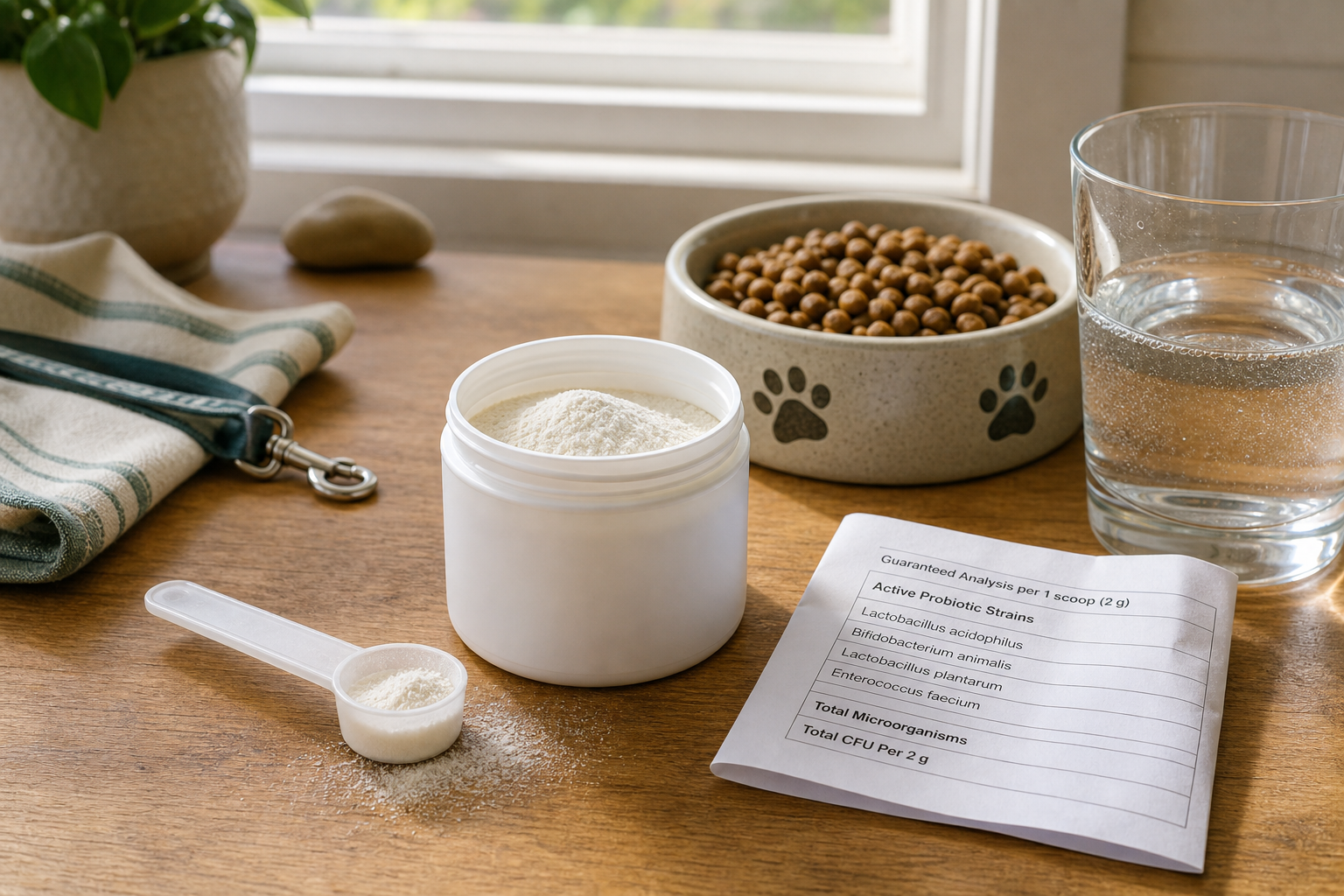
The label looks scientific. It doesn't have to feel that way.
Your vet just suggested a probiotic after your dog's antibiotic course, or maybe your dog's stomach has been off for weeks and you've decided to try one yourself. You pull up a product page, and suddenly you're reading about Lactobacillus acidophilus, "5 billion CFU," and a choice between a powder, a soft chew, and a capsule. It's a lot — and most label explainers either go way too deep into microbiology or stay so vague they don't actually help you decide anything.
Here's a plain-language walkthrough of what each piece of a dog probiotic label is actually telling you, and how to use that information when you're choosing between products.
What "CFU" means (and how many you actually need)
CFU stands for colony-forming unit — it's just the count of live, viable bacteria in one serving. A higher number means more bacteria delivered per dose. You'll typically see counts ranging from the low millions to tens of billions on dog probiotic products.
Bigger isn't automatically better here. What matters more is whether those bacteria survive the journey from the manufacturing facility, through your dog's stomach acid, and into the intestinal tract where they can actually do something. A product with a very high CFU count but poor shelf stability or no enteric protection may deliver far fewer live organisms than the label suggests by the time your dog eats it.
Look for products that guarantee CFU count at expiration, not just at the time of manufacture. That distinction matters. A label that says "5 billion CFU at time of manufacture" and one that says "5 billion CFU through expiration" are not the same product.
Decoding the strain names
The Latin names on probiotic labels follow a standard two-part format: genus first, then species. So Lactobacillus acidophilus means genus Lactobacillus, species acidophilus. Some labels go a step further and include a strain designation — a code like "DSM 13241" or "NCIMB 30005" after the species name. That level of specificity is a good sign; it means the manufacturer can trace exactly which strain was used and, ideally, what research backs it.
For dogs, the strains you'll see most often fall into a few families:
- Lactobacillus species — commonly studied for supporting gut lining integrity and managing loose stools, particularly after antibiotic use.
- Bifidobacterium species — associated with the large intestine; often included in formulas aimed at dogs with chronic digestive sensitivity.
- Enterococcus faecium — a strain frequently found in dog-specific probiotics; well-studied in veterinary contexts for general digestive support.
- Bacillus species — spore-forming bacteria that are naturally more heat- and acid-resistant, which makes them a common choice in chew formats where heat during manufacturing is unavoidable.
A single-strain product isn't automatically inferior to a multi-strain one. If a product has one well-researched strain at a meaningful CFU count, it can outperform a blend of seven strains at low counts with no research behind them. Multi-strain formulas make sense when you're trying to support different areas of the gut simultaneously, but "more strains" as a marketing claim means nothing on its own.
The powder vs. chew vs. capsule decision
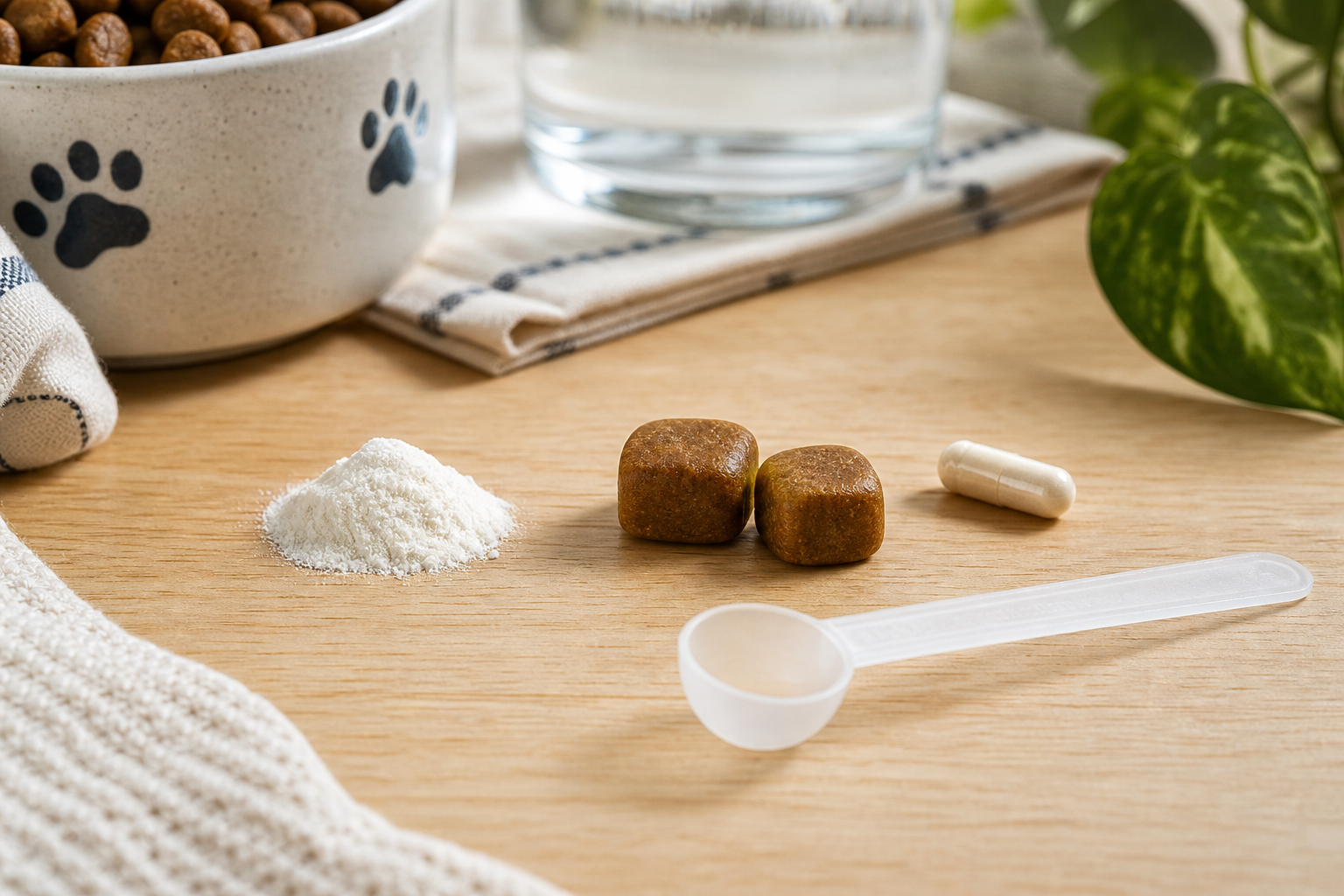
This is where most people get stuck, and it's honestly the most practical choice you'll make. Each format has real trade-offs.
Powders
Powder is the most flexible format. You mix it into food, which means dosing is easy to adjust, and it works well for dogs who won't take a chew or a pill. The downside: live bacteria in powder form are more exposed to moisture and air, so storage matters. Keep the container sealed and away from heat. Powder is also a good call for dogs with food sensitivities, since most formulas have minimal added ingredients.
If your vet has recommended a probiotic specifically to support recovery after antibiotics or a GI upset, powder mixed into a bland meal (plain boiled chicken and rice, for example) is often the easiest way to get consistent daily dosing without fighting your dog about it.
Soft chews
Chews are convenient and most dogs take them willingly — sometimes too willingly, which means you need to store them somewhere your dog can't self-serve. The trade-off is that the manufacturing process for soft chews involves heat and moisture, which can kill live bacterial cultures. That's why many chew formulas use spore-forming Bacillus strains rather than Lactobacillus — spores survive the process. It's not a problem, but it does mean the strain profile in a chew will often look different from a powder targeting the same outcome.
Chews also tend to have more added ingredients — binders, flavoring, sweeteners — which is worth checking if your dog has known food sensitivities or allergies.
Capsules
Capsules offer good protection for live cultures and are easy to dose accurately. Some dogs take them tucked into a piece of food; others don't. If your dog is already practiced at taking capsule-form supplements, this format works well. Some capsules are designed to be opened and mixed into food, which gives you the flexibility of a powder with the shelf stability of a sealed capsule.
What the "other ingredients" list is actually telling you
Scroll past the probiotic strains on any label and you'll hit the inactive ingredients. This section matters more than most people realize. For dogs with chicken allergies, a chicken-liver-flavored chew is an obvious problem. But also watch for:
- Xylitol — a sweetener that is toxic to dogs. It's rare in pet products but worth confirming it's absent.
- Artificial colors and flavors — not dangerous in most cases, but unnecessary, and some sensitive dogs react to them.
- Fillers and binders — maltodextrin, cellulose, and similar ingredients are generally fine, but a long inactive ingredient list in a "simple" probiotic is worth a second look.
A short, readable ingredient list is usually a better sign than a long one, all else being equal.
Matching the product to the situation
Not every probiotic is trying to do the same job. Here's a rough framework for matching what's on the label to what your dog actually needs:
- Post-antibiotic recovery: Antibiotics disrupt the gut microbiome broadly. Look for a multi-strain formula with both Lactobacillus and Bifidobacterium species, at a meaningful CFU count, ideally with a guaranteed-at-expiration claim. Powder or capsule formats tend to work well here.
- Chronic loose stools or sensitive stomach: Consistency matters more than anything. Pick a format your dog will actually take every day without a battle — usually a chew or powder mixed into food. Look for strains with veterinary research behind them, like Enterococcus faecium or well-documented Lactobacillus strains.
- General maintenance: If your dog's digestion is fine and you're adding a probiotic as a preventive measure, a straightforward single- or dual-strain product at a moderate CFU count is plenty. No need to reach for the most complex formula on the shelf.
- Picky eaters: Powder wins here — it disappears into food. Chews can work if the flavor is appealing enough, but some dogs will eat around them or spit them out.
One thing worth asking your vet
If your dog is on any medication or has a diagnosed GI condition, it's worth a quick check with your vet before starting a probiotic — not because probiotics are generally risky, but because some conditions (like certain immune disorders) call for specific guidance. For healthy dogs with run-of-the-mill digestive sensitivity, the conversation is usually short. But it's worth having, especially if you're adding a supplement after a health event rather than as routine maintenance.
The label on a dog probiotic doesn't have to be a wall of confusion. Once you know what CFU guarantees actually mean, which strain families do what, and why the format you choose affects which strains are even viable, you can make a genuinely informed pick — not just grab whatever has the highest number on the front of the bag.
Find dog probiotics and digestive health supplements at Petocart — with free shipping across the USA, it's easy to get the right formula to your door without the guesswork.
Frequently Asked Questions
How long does it take for a dog probiotic to start working?
It depends on what you're trying to address. For acute digestive upset — like loose stools after antibiotics — many dog owners notice improvement within a few days to a week of consistent use. For chronic sensitivity or general gut maintenance, it can take several weeks of daily dosing before you see a clear difference. Consistency matters more than speed here; skipping doses resets the process.
Can I give my dog a human probiotic instead of a dog-specific one?
Some human probiotic strains — like certain Lactobacillus and Bifidobacterium species — are also found in dog-specific formulas, so a human probiotic isn't automatically harmful. The bigger concern is the other ingredients: some human products contain xylitol or high doses of certain vitamins that aren't safe for dogs. Dog-specific formulas are formulated with appropriate dosing and safe inactive ingredients, which makes them the safer default. Check with your vet if you're considering a human product.
Does "dog probiotic powder" need to be refrigerated?
It depends on the strains and how the product was manufactured. Some powders contain live cultures that are more stable at room temperature, especially if they use spore-forming strains or freeze-dried bacteria. Others require refrigeration to maintain viable CFU counts through expiration. Always check the storage instructions on the label — and if a product says refrigerate after opening, that guidance is there for a reason.
Is a higher CFU count always better for dogs?
Not necessarily. A very high CFU count only matters if those bacteria are actually alive and able to survive stomach acid to reach the intestines. Stability, strain selection, and whether the count is guaranteed at expiration (not just at manufacture) are all more meaningful than the raw number on the front of the package. A product with a moderate CFU count from well-researched, stable strains will often outperform a high-count product with poor shelf stability.